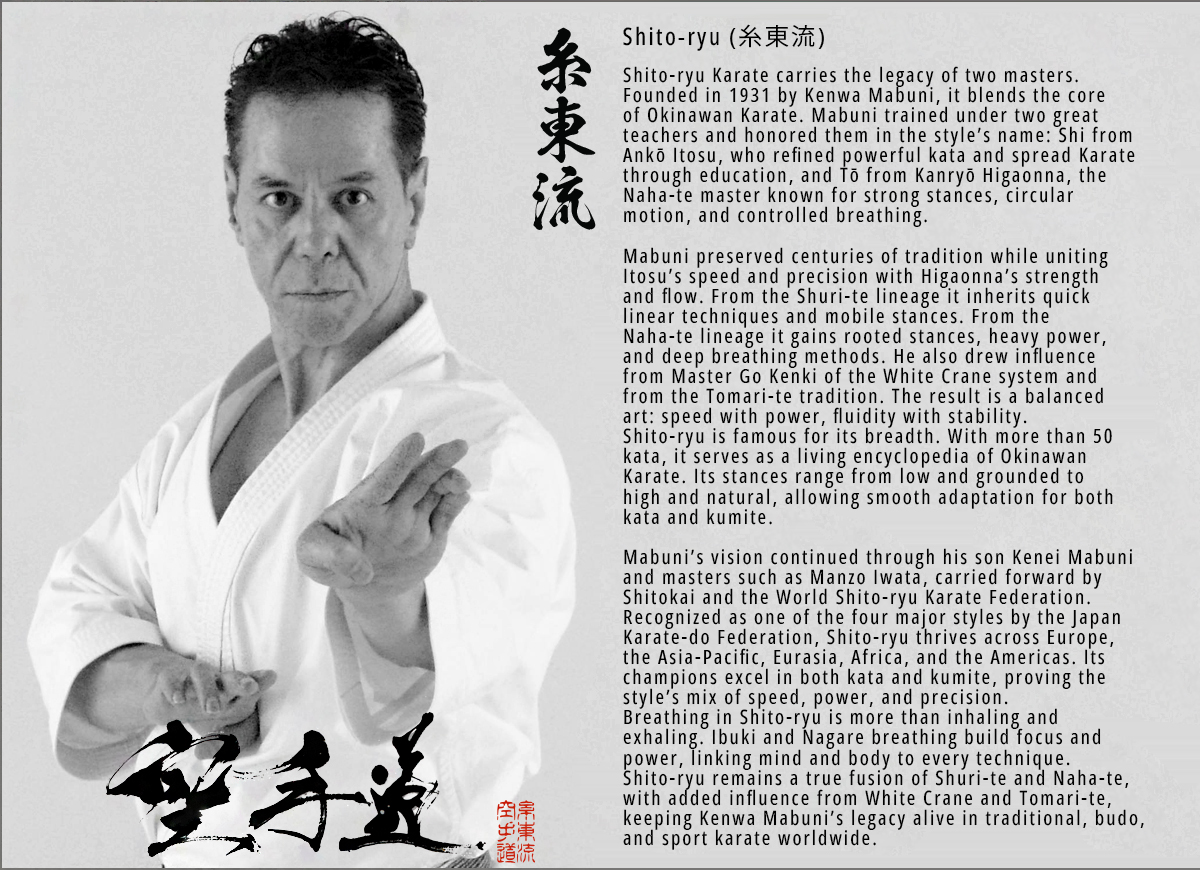
Shito-ryu Karate carries the legacy of two masters. Founded in 1931 by Kenwa Mabuni, it blends the core of Okinawan Karate. Mabuni trained under two great teachers and honored them in the style’s name: Shi from Ankō Itosu, who refined powerful kata and spread Karate through education, and Tō from Kanryō Higaonna, the Naha-te master known for strong stances, circular motion, and controlled breathing.
Mabuni preserved centuries of tradition while uniting Itosu’s speed and precision with Higaonna’s strength and flow. From the Shuri-te lineage it inherits quick linear techniques and mobile stances. From the Naha-te lineage it gains rooted stances, heavy power, and deep breathing methods. He also drew influence from Master Go Kenki of the White Crane system and from the Tomari-te tradition. The result is a balanced art: speed with power, fluidity with stability.
Shito-ryu is famous for its breadth. With more than 50 kata, it serves as a living encyclopedia of Okinawan Karate. Its stances range from low and grounded to high and natural, allowing smooth adaptation for both kata and kumite.
Mabuni’s vision continued through his son Kenei Mabuni and masters such as Manzo Iwata, carried forward by Shitokai and the World Shito-ryu Karate Federation. Recognized as one of the four major styles by the Japan Karate-do Federation, Shito-ryu thrives across Europe, the Asia-Pacific, Eurasia, Africa, and the Americas. Its champions excel in both kata and kumite, proving the style’s mix of speed, power, and precision.
Breathing in Shito-ryu is more than inhaling and exhaling. Ibuki and Nagare breathing build focus and power, linking mind and body to every technique. Shito-ryu remains a true fusion of Shuri-te and Naha-te, with added influence from White Crane and Tomari-te, keeping Kenwa Mabuni’s legacy alive in traditional, budo, and sport karate worldwide.
糸東流空手は二人の師の遺産を受け継いでいます。1931年、摩文仁賢和によって創始され、沖縄空手の核心を融合しました。摩文仁は二人の偉大な師に学び、その名を流派名に刻みました。**糸(シ)**は強力な型を洗練し、教育を通して空手を広めた糸洲安恒、**東(トウ)**は強い立ち方、円の動き、そして制御された呼吸で知られる那覇手の師、東恩納寛量を指します。
摩文仁は糸洲の速度と精度、東恩納の強さと流れを結び付け、数世紀の伝統を守りました。首里手からは素早い直線技と機動性のある立ち方を、那覇手からは根付いた立ち方、重厚な力、深い呼吸法を受け継ぎました。また白鶴拳の呉賢貴師や泊手の伝統からも影響を受けています。
その結果、速度と力、流動性と安定性を兼ね備えた均衡の取れた武道となりました。糸東流はその広さでも知られます。50を超える型を持ち、沖縄空手の生きた百科事典ともいえます。低く安定した立ち方から高く自然な立ち方まで、多様な立ち方は形や組手のどちらにも柔軟に適応します。
摩文仁の志は、息子の摩文仁賢榮や岩田万蔵などの師範たちによって受け継がれ、糸東会や世界糸東流空手連盟を通じて広がりました。
日本空手道連盟により四大流派の一つとして認められた糸東流は、ヨーロッパ、アジア太平洋、ユーラシア、アフリカ、アメリカ大陸などで発展し続けています。型と組手の両方で活躍する選手たちは、この流派の速度、力、精度を証明しています。
糸東流における呼吸は単なる吸う吐くだけではありません。息吹(いぶき)と流れ(ながれ)の呼吸法は集中力と力を養い、心と体を一つに結び技へとつなげます。
糸東流は首里手と那覇手を真に融合し、白鶴拳や泊手の影響も取り入れ、摩文仁賢和の遺産を伝統・武道・スポーツ空手の世界で今日も生き続けています。