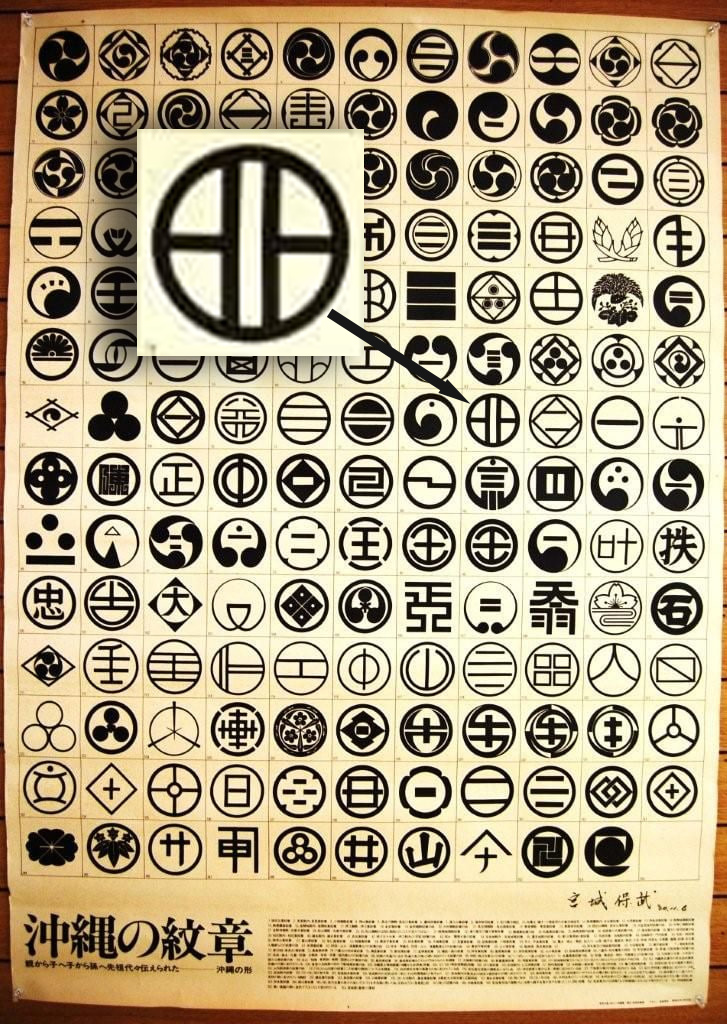
沖縄の紋章 (Okinawa no Monsho) refers to the traditional family crests of the Ryukyu Islands, known in Japanese as kamon. These emblems were used by Okinawan noble families and warriors to show lineage, status, and identity, much like coats of arms in Europe. Their designs often feature natural elements such as waves, flowers, and animals, along with geometric patterns, each carrying symbolic meaning linked to protection, prosperity, or heritage. Today these crests remain important cultural symbols, appearing on clothing, architecture, and ceremonial items to honor Okinawa’s history and ancestry.
Uni Ufugusuku (ca. 1450) was a famous Okinawan bushi and royal bodyguard. His birth name was Uni Oshiro, and the nickname Uni Ufugusuku means “large-bodied demon or spirit.” According to Okinawan tradition, four family lines trace their ancestry to him:
• Mabuni
• Hokama
• Nakamoto
• Oshiro
Among these four, only the Mabuni and Hokama families continue to use a kamon (family crest), also called monsho The meaning of this monshō is described as shungan, means straight and strong like solid rock, symbolizing firmness and power.
Master Kenwa Mabuni, founder of Shito-ryu Karatedo, adopted his family crest for his karate style and explained it as a symbol of harmony and of two persons (hito “人”) joined in cooperation to preserve peace in the world. The outer circle represents harmony. The two parallel vertical lines with the horizontal line between them signify the blending of Shuri-te from Grandmaster Anko Itosu and Naha-te from Grandmaster Kanryo Higaonna. The emblem expresses the harmony of Shuri-te and Naha-te and, more broadly, the unity of all directions of the art of Te.