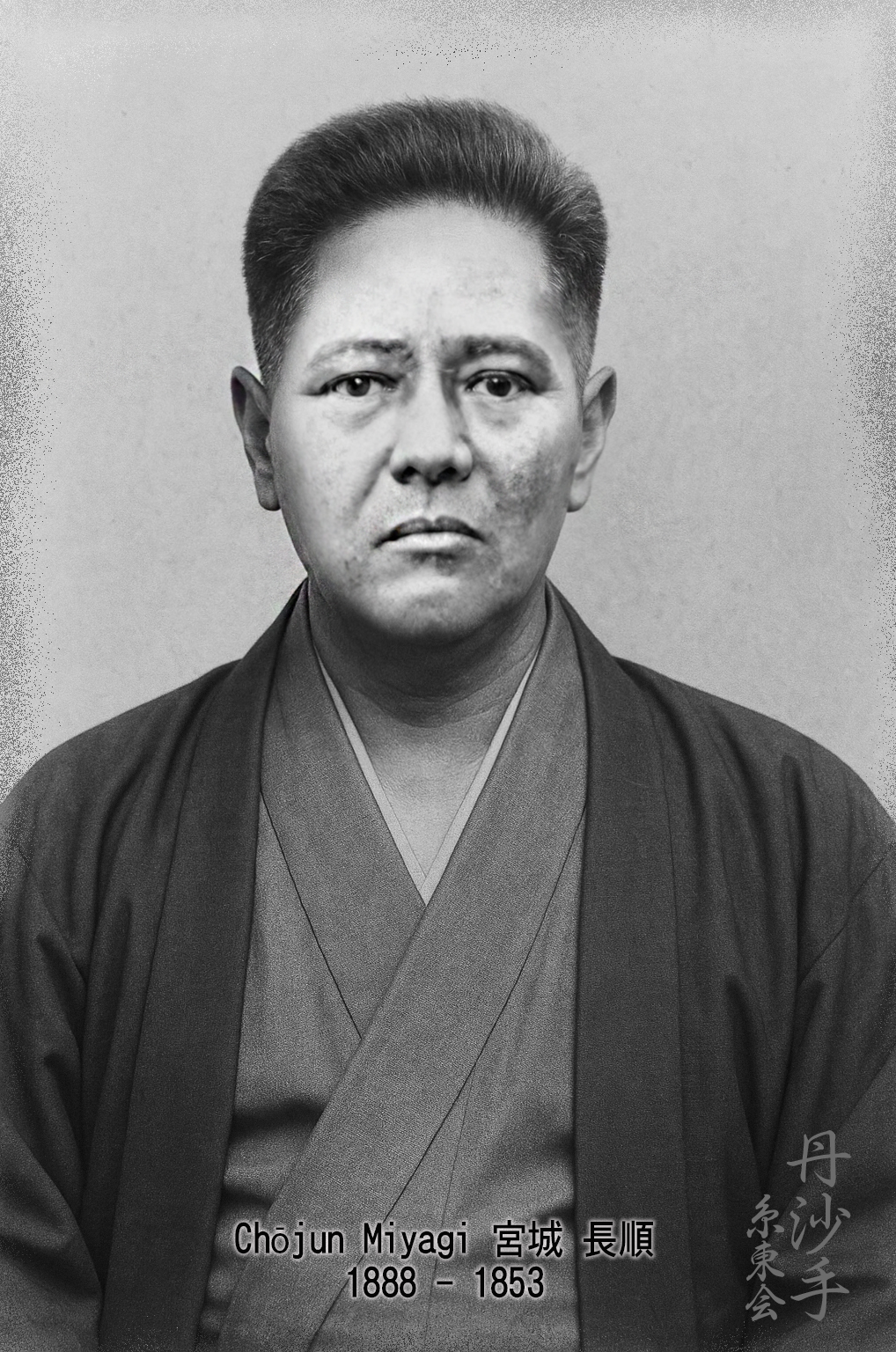
Chōjun Miyagi (1888 to 1953)
Chōjun Miyagi was one of the most significant figures in the history of Okinawan karate and the founder of Gōjū-ryū, one of the four major traditional karate styles. Born in Naha, Okinawa, into a wealthy family, Miyagi began his martial arts training at the age of 11. His first formal teacher was Ryuko Aragaki, who later introduced him to Kanryo Higaonna, a legendary master of Naha-te, a Chinese-influenced Okinawan fighting style. Under Higaonna’s strict guidance, Miyagi trained with deep intensity and dedication for over 15 years, becoming his most prominent student and the natural successor to his teacher’s knowledge.
To deepen his understanding of martial arts, Miyagi traveled to Fuzhou, China, in 1915, where he studied Chinese boxing and internal arts. This journey had a lasting influence on his approach to martial arts, emphasizing the balance between “hard,” go, and “soft,” ju, techniques, a philosophy that shaped the name and essence of Gōjū-ryū. Miyagi was known for his physical power, refined technique, and scholarly approach. He formalized kata like Sanchin and Tensho, integrated breathing methods, and developed a complete training system rooted in both physical and spiritual development.
Miyagi’s contribution went beyond technical mastery. He worked tirelessly to legitimize karate as a formal discipline in schools and the military, striving to elevate it to the same cultural status as judo and kendo in mainland Japan. His efforts led to the recognition of karate by the Dai Nippon Butokukai, Japan’s governing body for martial arts at the time. He also served as a physical education instructor at several institutions, further spreading karate among the youth of Okinawa.
A particularly important chapter in Miyagi’s life was his friendship and collaboration with Kenwa Mabuni, the founder of Shitō-ryū karate. The two men shared deep mutual respect and frequently exchanged ideas. Their friendship was both personal and important in shaping the direction of modern karate. Mabuni often credited Miyagi’s technical precision and philosophical depth as inspirations, while Miyagi greatly respected Mabuni’s scholarly research and efforts to unify Okinawan and Japanese martial traditions. Together, they stood at the heart of the early 20th-century karate renaissance, helping to refine and document the art for future generations.
Master Chōjun Miyagi passed away in 1953, but his teachings continue to influence martial artists around the world. Gōjū-ryū remains one of the most practiced and respected karate styles globally, characterized by its powerful stances, dynamic breathing, and smooth transitions between hard and soft techniques. Miyagi is remembered for his brilliant technique and for his deep understanding of karate as a path of lifelong cultivation of body, mind, and spirit.